.png?width=73&height=36&name=Logo%20(1).png)


Originally Posted July 2, 2018 on Linkedin
Blog
The False Choice Between Insulin Pens and Pumps

For as long as many of us can remember, living with Type 1 diabetes has felt like a binary choice. You are either a "pumper," tethered to a device 24/7 in exchange for automation, or you are on "MDI" (multiple daily injections), embracing the freedom of a pen but shouldering the mental math of every single decision yourself.
But life rarely fits neatly into two boxes.
For too long, people living with diabetes have faced a false choice between two extremes. On one side, the commitment and visibility of an insulin pump; on the other, the freedom of pens, but with the burden of managing every dose and decision alone. Millions of us fall in between—capable, engaged, and tech-savvy—yet neither option truly fits our lives. We crave the peace of mind and support that technology can offer, but we refuse to give up our agency or our freedom.
Recognizing this false choice is critical to the future of diabetes management. For years, it’s felt like you could only choose between a pump or a pen—two extremes, neither of which fully fit the realities of life with diabetes for so many of us. But now, there’s finally another way forward. Luna exists to break down that old binary, creating a new, genuine option for those who have always felt caught in the middle.
The Unmet Needs in Diabetes Management
Why does this gap exist? Why do so many of us hesitate to adopt Automated Insulin Delivery (AID) systems, even when the industry tells us they are the "gold standard"?
A fascinating concept recently explored by Dan Heller, in his article "The Performance Paradox of Automated Insulin Delivery,"¹ calls this the "Performance Paradox" of AID systems. The research, drawing on a decade of clinical trials and peer-reviewed publications, suggests that the benefits of automation are often distributed in a bell-shaped pattern. On one end, you have those who struggle significantly with self-management—usually children or the newly diagnosed—who see life-changing benefits from pumps. On the other end, you have the "hyper-engaged" users who hack and tweak their algorithms to perfection.
But then there is the middle group—the vast majority of adults living with diabetes.
The Paradox of the "Middle Group"
This middle group consists of people who know their bodies. You know your carb ratios, you understand how exercise affects your blood sugar, and you are capable of achieving great results. For this group, the data shows something surprising: moving to a fully automated system often doesn't lead to better outcomes.
The Cost of "Set It and Forget It"
Furthermore, the trade-offs for this automation are steep. We aren't just talking about the financial burden—multiple studies show that pump users face significantly higher lifetime costs than pen users, with analyses like the DIAMOND Randomized Trial finding pump therapy to be over $100,000 more expensive across a lifetime, and European cost-effectiveness studies confirming that this added cost only yields benefit when starting A1c levels are high (>8%).5 We are also talking about the emotional and physical toll.
Many of us who have chosen pens do so because we value our bodily autonomy. Our team has helped shape this experience—creating solutions like the InPen (acquired by Medtronic) and the Bigfoot Unity pen cap (acquired by Abbott Diabetes)—that have proven smart pens can empower people with better insights and greater confidence throughout the day. But as much as these innovations have helped, we know the most significant unmet need in diabetes today is safe, restful nights. We still struggle with the "hassle factor" of wearing a device that beeps, alarms, and requires constant site changes. We worry about the creeping weight gain that often accompanies the "over-basalization" of automated delivery.¹ That is precisely why our focus now is on closing this gap—so you don't have to compromise as you move from day to night.
We are left with a difficult compromise: Do we choose the mental burden of manual injections to keep our physical freedom? Or do we accept the physical burden of a pump to ease the mental load?
Until now, we haven't had a third option.
Luna’s Role in Bridging the Gap
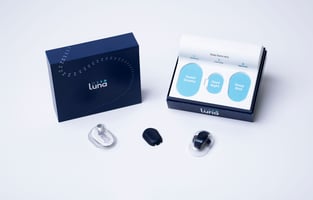
At Luna, we believe you shouldn't have to compromise. Our team has already shaped the landscape of daytime diabetes to give people smarter, more confident insulin dosing throughout the day. Now, we’re building on that legacy by turning our focus to nights—because we know restful, worry-free sleep remains the most significant unmet need in diabetes today. Luna was created to provide a true third option: data-driven technology support without the tether of a traditional pump, especially when you need it most—overnight.
Smart Support, Not Just Automation
Luna bridges the gap by combining the simplicity and familiarity of an insulin pen with the intelligence of automated delivery, with a particular focus on nighttime management. We know that the fear of nighttime lows and the exhaustion of interrupted sleep are two of the most significant stressors for people on MDI.
Instead of demanding you wear a device 24/7, Luna integrates with your life. It offers the "smart insights" and peace of mind that come from CGM connectivity, allowing you to make data-driven decisions without the constant noise of unnecessary alarms. It empowers you to maintain your agency—you are still in the driver's seat—but you have a co-pilot that helps smooth out the road, especially while you sleep.
Reducing Decision Fatigue, Preserving Agency
- For the Pen User: It keeps you untethered during the day, respecting your lifestyle and your body.
- For the Tech Seeker: It provides the automated support needed to improve Time in Range and reduce anxiety, without the "hassle factor" that leads so many to discontinue pump therapy.
We are validating the choice to stay engaged. We believe that when you give capable people better tools rather than just more automation, they don't just survive—they thrive.
Conclusion
The "white space" between pens and pumps has been ignored for too long, leaving millions of us to choose between two imperfect options. But we don't believe you should have to choose between your health and your freedom.
The insights from the "Performance Paradox" validate what most of us have long felt: technology should support our human intelligence, not replace it. By acknowledging the unique needs of capable, engaged adults, we can move beyond the binary of "pen vs. pump" and embrace a future that is flexible, personalized, and empowering.
Luna is more than just a device; it is a commitment to that future. It is our way of saying that your agency matters, your sleep matters, and your peace of mind is worth fighting for.
If you are ready to find a balance that actually works for your life, we invite you to join us on this journey.
Footnotes
- Heller, D. (2025). Medical Literature Analysis: The Performance Paradox of Automated Insulin Delivery. Substack. https://danheller.substack.com/p/performance-paradox-of-automated-insulin-delivery
- Michaels D, Boucsein L, et al., Diabetes Technology & Therapeutics, 2024.
- "Advanced hybrid closed loop therapy versus conventional treatment in adults with type 1 diabetes (ADAPT)," Lancet Diabetes Endocrinology, 2023.
- T1D Exchange Research Study, 2018; cited in Heller, D. (2025).
- DIAMOND Randomized Trial; cost and quality of life analysis.
- “Obesity in people living with type 1 diabetes,” The Lancet, 2021.
- “Prevalence and Management of Obesity in U.S. Adults With Type 1 Diabetes,” Johns Hopkins/CDC NHANES, 2023.
- “Diabetes Device Use in Adults With Type 1 Diabetes: Barriers to Uptake and Potential Intervention Targets”, Diabetes Care, 2017.
- “Barriers and facilitators to diabetes device adoption for people with type 1 diabetes”, Diabetes Care, 2017.
- “Cardiorespiratory Fitness and Mortality Risk Across the Spectra of Age, Race, and Sex,” 2022 study of 750,302 U.S. veterans.
- “Time in Range for Closed-Loop Systems versus Standard of Care during Physical Exercise in People with Type 1 Diabetes: A Systematic Review and Meta-Analysis.”