.png?width=73&height=36&name=Logo%20(1).png)


Every sleep tracker eventually gives you the same advice: make your room cooler, ditch the screens,...
Blog
What almost 600 people living with diabetes told us, in a sentence
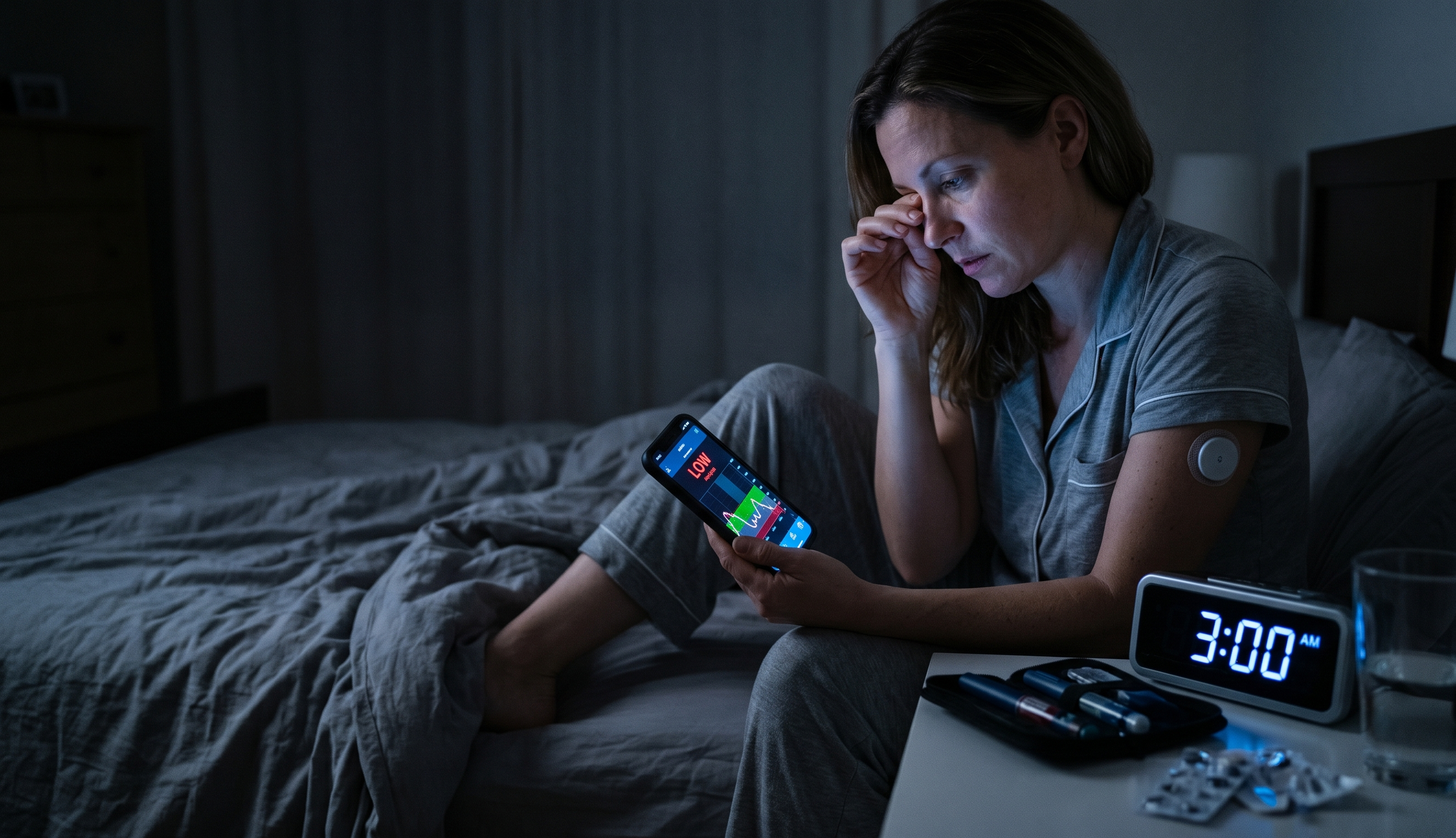
3 a.m., when you live with diabetes, has a particular quality. The CGM alarms. The math in the dark. The random wake up when something feels off. The question of whether to correct or wait, knowing you'll have to wake either way again.
If you live with insulin-dependent diabetes. You already know. But how deeply does this impact our lives? We asked.
Earlier this year, we commissioned an independent research firm to ask almost 600 people living with or treating people with diabetes a single question: what do they most want to accomplish? Not what their devices do. Not how their A1C looks. Not what their Time in Range is. What they actually want their life with diabetes to feel like. dQ&A fielded the study across people with Type 1 and Type 2 diabetes who take insulin by injection — pens, not pumps — all using continuous glucose monitors, all making real choices about how to live with insulin.
We knew sleep would be important. We didn't anticipate how much.
Across the full sample, the single highest-ranked unmet need was uninterrupted sleep. Among adults using pens, it ranked first of twelve. Three of the top four were nighttime needs. The headline is the directional finding: when you give people living with diabetes a chance to rank what matters most, the night wins. Or loses, depending on how you look at it.
You may not know that 31% of people in this study reported intentionally going to bed with elevated glucose because the alternative is worse. That is not a failure of management. That is a competent person making a rational choice in a system that has not given them a better one.
The published evidence has pointed this way for years. Nearly half of adults with Type 1 diabetes report poor sleep quality, and that quality tracks with overnight glucose swings and the fear of going low while asleep (Martyn-Nemeth et al., 2018). CGM-confirmed nocturnal hypoglycemia worsens sleep quality the next morning, even when the person never woke for the event (Pillar et al., 2023). And sleep is increasingly recognized as a modifiable pillar of Type 2 management — not a side effect of glucose control, but a lever in its own right (Reutrakul & Van Cauter, 2024).
The research community has been doing the work. The data is there. What our study did was put the question directly to the people who live this every day and let them rank it. They ranked the night.
The night is the one part of the day that a person cannot manage manually. You cannot bolus while you are dreaming. You cannot adjust while you are asleep. You cannot hear an alarm if you are deeply under. The hours when risk is highest are the hours when human vigilance is structurally impossible. Those are the hours the people in our study (and the people in every published sleep study before ours) asked us to address.
Sleep-only automation works while you sleep and steps back when you wake. It is built for pen users who own their days and want their nights protected. It is a new category, designed for a different need — one that people in our study named clearly, and that the field's own evidence has been building toward for years.
We are writing this because if you live with diabetes, or love someone who does, you should know that what you have been feeling at night is not a personal shortcoming. It is a system-level gap. And it is solvable.
What "solved" sounds like was never ours to define. The people in our study said it themselves, in a single sentence: "My sleep is uninterrupted by my diabetes."
That is what we are building. For the full findings, including the segmentation across Type 1 and Type 2, the ranked tables, and the comparison to the existing literature, be sure to read our upcoming white paper.
Nights protected. Days yours™.